

Contributor Leaderboard
-
Pegwoman
New Members7Points53Posts -
.jpg.cdd7f8371d17e2f2f2e2a0e21e02f727.jpg) 5Points3,654Posts
5Points3,654Posts

.thumb.jpg.7493ddab4a696108cf2b849323d3c155.jpg)
Popular Content
Showing content with the highest reputation on 26/10/25 in Posts
-
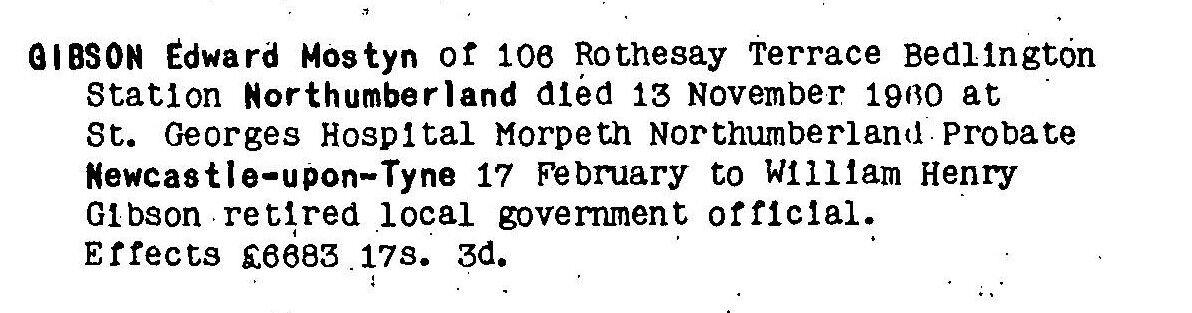
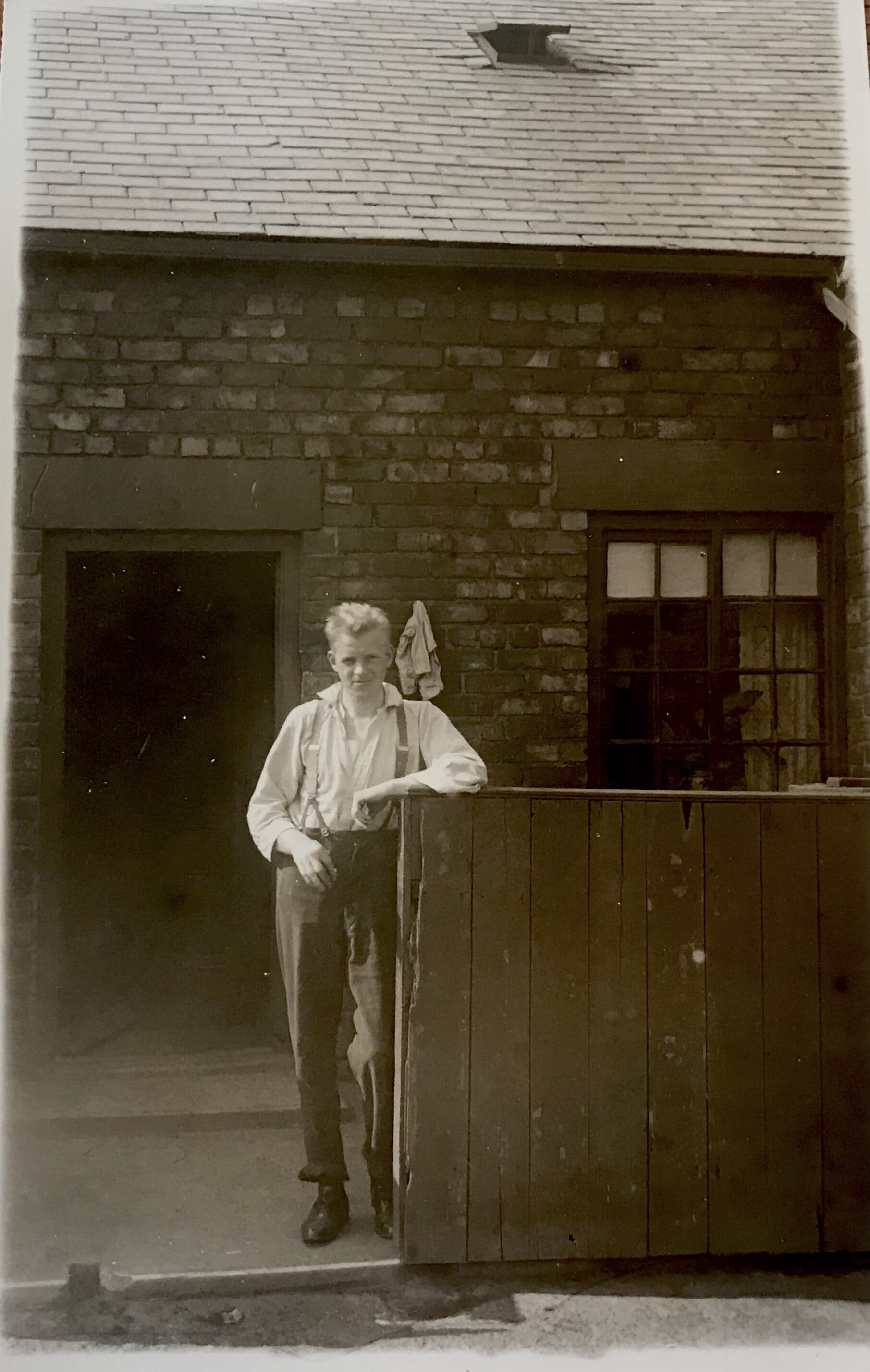
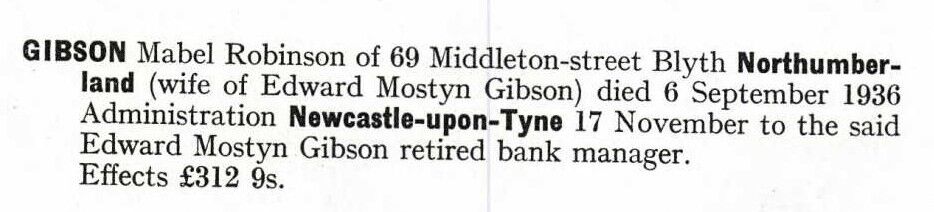
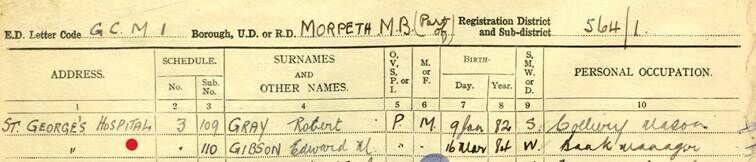
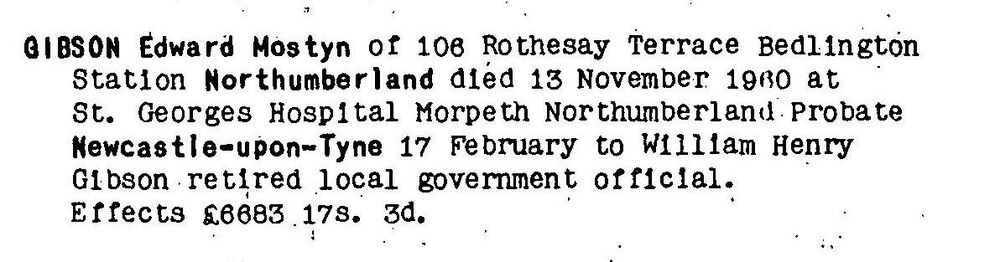
2 pointsAnd finally, there was bank manager Edward Mostyn Gibson. What happened to him? He has been extremely difficult to find and here’s the reason why. In September 1936 Edward Mostyn’s wife, Mabel, dies at the age of 51 years. Her address is then given as Middleton Street, Blyth. One can only wonder why. After a great deal of searching I eventually found the first trace of Edward Mostyn’s whereabouts in 1939 – and possibly a reason for his wife being in Blyth. He was at that time a patient in St Georges Hospital, Morpeth. How long he had been there is impossible to say. Mental Health Care wasn’t exactly at it’s best in 1939 and admissions were more frequent than discharges. What I can say with certainty is that Edward Mostyn died in St George’s Hospital though, again, it’s impossible to say how long he had been there. At the time of his death, he did however own a home in Bedlington – 106 Rothesay Terrace – next door to his brother at 105 (106 was vacant in the 1939 register when Edward M was in hospital). Those effects are worth only £14,745 today. A sad end to an enterprising family and a big piece of Bedlington’s history. Hope you’ve enjoyed reading this as much as I’ve enjoyed researching it.
 2 points
 -
2 pointsCan Bedlington have its own museum. . . .? Having been involved with Beamish in the 1960s and then Woodhorn museum later on and the Northumberland Fusiliers museum at Alnwick Castle I wonder why the hell Bedlington hasn’t got its own museum. Grants and donations can be obtained I would love to be involved in such a project. My contribution would be financial and advice. Come on we deserve a museum.2 points
-
2 pointsMaybe Bedlington history society and you could join forces. BEDLINGTON needs its own museum. Maybe John Hall originally from North seats ,but went to Bedlington grammar school would donate the opportunities are there. It needs a team of volunteers to organise it. I was at school with Claire Mitchell ner mam wasEllen Mitchell. I am sure that her family would be involved. There are just so many people who would support this. Also I have an extensive collection of disaster glasses some that are unknown linked with Bedlington and guidepost, Anyway it’s just a thought2 points
-
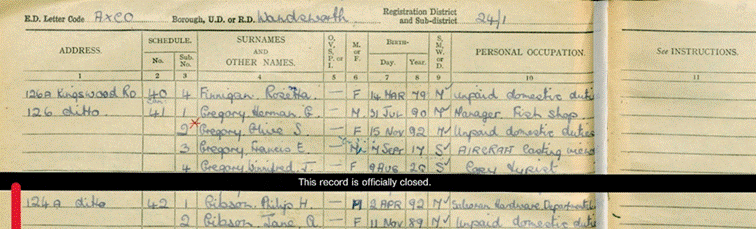
1 pointFirst and foremost, we can see that in 1939 Bank House was no longer in the possession of the Gibson family. It was now occupied by a mining family and, it seems to me, that the following family (at nr. 38) is living in the same building so possibly converted into flats. To come back to the youngest of the brothers, Philip Hedley Gibson, he seems to have continued in the field of selling. No doubt fuelled by his experience in the shop at Bank House, he has moved his family to the bright lights of Wandsworth, London where he is employed, not in any managerial position but as a salesman in a hardware department of a, presumably, larger, London store. Could one of his older brothers have taken on the ironmongers business in Bedlington? Unfortunately not. Brother William Henry Gibson continued to live on Rothesay Terrace but now at number 105. His occupation is then given as “Air Raid Precaution Clerk” with “Bedlington U, D, Council” so he has, presumably left the drapery business. Note that nr. 106 is vacant (V in margin). The place is not unoccupied but the resident is not available.

 1 point
 -
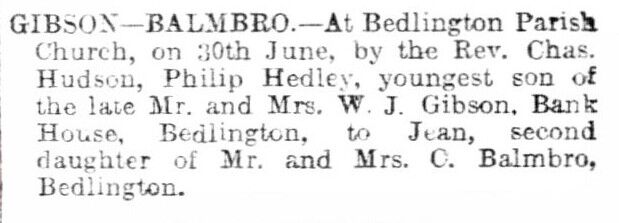
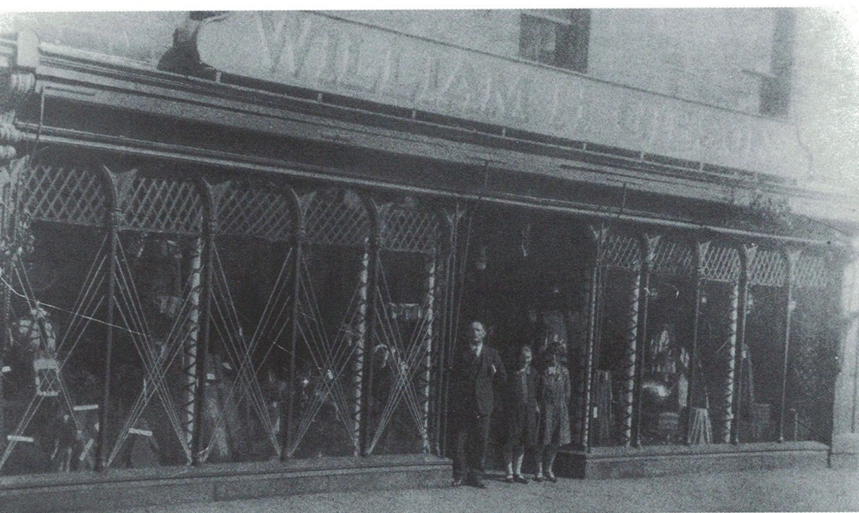
1 pointThere has been very little information available after the 1911 census for the Gibson family but thanks to the release of the 1921 census research has now been made a little easier. In 1911 both Philip Hedley Gibson and his brother, Edward Mostyn Gibson were involved, albeit on different levels, with ironmongery. Edward M was, together with his father, joint manager in the ironmongery business. Philip H was working for them as an apprentice shopkeeper in the family shop at Bank House. After the death of their father, Edwin Mostyn takes over the management of the ironmongery business while continuing with his banking interests. Both Edwin and Philip are single and living at Bank House. In 1917 Edwin Mostyn marries. His bride is Mabel Robinson Turner of Blyth and she moves to her husband’s home. Three years later, in June 1920, Philip Hedley also marries and also brings his wife, Jean Balmbro, to Bank House. Jean appears to be the sister of his brother William Henry’s wife. Note: The name “Jean” would appear to be a misprint as her name is given as “Jane A” in the marriage index and as “Jane Ann” in the 1921 census. One year later, in 1921 the two sons and their wives are sharing the 10 rooms of Bank House. Philip H has completed his apprenticeship and is now entitled to call himself an ‘ironmonger’. He is stated to be an “employer” (rather than a worker, as previously) so seems to be in a managerial position in the business – if not the sole owner. I say the latter because his brother, Edward Mostyn, gives his occupation only as “Bank Manager” and his “employer” as “Bank of Liverpool and Martins Ltd.” but I can see from Kelly’s Directory that he is also engaged as “treasurer of the Urban District Council” of Bedlington. Both men give their place of work as “Front Street, Bedlington” so are presumably working from Bank House. By 1921 brother William Henry has left Bank House and has purchased a property at 89 Rothesay Terrace where he now lives. He is, however, still working at Hedley Young & Co. Ltd., drapers, on the south side of Front Street East, almost opposite Bank House. William Henry went on to become successful in his own drapery business and I’m sure you’ll recognise the premises, with its very distinctive arched windows, on Front Street East – the former ‘Dunns the Drapers’ which I’ve mentioned earlier in connection with the Gibson family. That’s William Henry in the shop doorway but I haven’t been able to identify the two girls. What happened to the three brothers and the family Ironmongers business after 1921? Fortunately, in September 1939, prior to the second world war which was looming on the horizon, the British Government decided to make an inventory of what human resources were available should they be needed. The gap is large between the census of 1921 and the ‘1939 register’, as it came to be known, and there is very little means of finding out which paths the brothers, William Henry, Philip Hedley and Edward Mostyn trod during those intervening years but we can get a glimpse of how it all turned out.
 1 point
 -
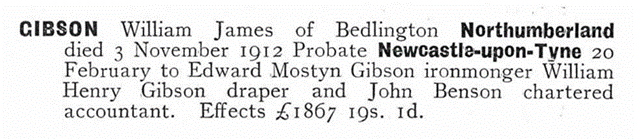
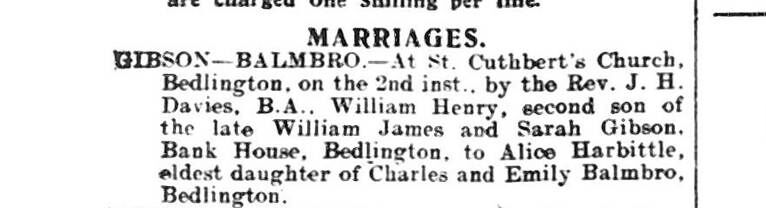
1 pointIt's been a while but I have managed to do a fair bit of research between dahlias and geraniums. I'd like to get this finished before I fly off to the sun and return to piles of autumn leaves and snow. I've managed to get all my notes written up this week so here's the result. It'll probably need a few posts. Now, where did I leave off? Henry Gibson, head of the family, had died in 1902 at an age of 80 years. His son, Phillip Hedley Gibson – widowed and with no heirs – had followed him to the grave in 1906 leaving his brother, William James, to shoulder the responsibility of running the business. William James was then living in Vulcan Place with his wife Sarah (nee Mostyn) and their children: Mary, Edward Mostyn, William Henry, Lilian, James and Philip Hedley. However, by 1911 he and his family have moved back to Bank House on Front Street East. It has presumably been inherited after Philip’s death in 1906. There are, however, some notable changes in the family in 1911. William James Gibson is still in business as an “Ironmonger & Bank manager” and the property on front street is now described by the enumerator as being a “house and shop”. William James is also widowed but I haven’t been able to ascertain exactly where or when Sarah died. There is a death for a Sarah Gibson, 57 years old, registered in the first quarter of 1911 at Morpeth registry office – just prior to the census being done on April 2nd 1911. On that date three nieces of Sarah (daughters of Sarah’s two sisters), are shown on the census form as being at Bank House. Could they have been there because of Sarah’s death? Unfortunately, Sarah’s death has not been the only grief suffered by the family. In 1908 daughter Lilian had died aged 21 years, at which point, according to the newspaper obituary, her mother Sarah still lived and the family address is given as “North Eastern Bank” ie. Bank House. The only remaining daughter in 1911, Mary 28 years old, is still single and living at home, most likely taking care of the household now that her mother is gone. Also at home at Bank House are sons Edward Mostyn Gibson 27, William Henry Gibson 25, James Gibson 20 and Philip Hedley Gibson 19. The four sons were soon to be left fatherless, however, when William James Gibson dies November 3rd 1912 aged 57 years. He is sadly followed by son James, then 26 years old, in 1917. Those effects are worth approx. £275,450 today, so he didn’t do too badly either. Of the remaining three sons, only Edward Mostyn- and Philip Hedley Gibson have followed their father into the ironmongery business. The eldest, Edward Mostyn, is an ironmonger and also a bank clerk, while brother Philip Hedley concentrates solely on a career in ironmongering. At the age of 19 he is still learning the ropes as an apprentice shop-keeper, presumably in the family shop at Bank House but more about them later. Brother, William Henry, doesn’t appear to follow in the family trade choosing instead to follow his career in the drapery business. In 1911, now aged 25, he has completed his apprenticeship and is working as a draper’s shop assistant. The girl he will marry two years later in 1913, 23-year-old drapery colleague Alice Harbottle Balmbro, is also recorded as a visitor to Bank House in 1911. So, is this the end of an era for the Gibson Brothers Ironmongery business? Now, with their father dead and William H engaged in the drapery trade, only Edward Mostyn and Phillip Hedley remain to carry on the work started 88 years earlier by Phillip Gibson in 1814 – but will they do so?
 1 point
 -
1 pointThanks. I suppose that the council knows who owns the land. I will ring them. If they do maybe they will donate it.1 point
-
1 pointThanks for the info about the land. It was an uncle of mine who kept everything and we had to have an extension built to house all his parents stuff. Friends and family who see it think it’s a time capsule. At the moment I am busy cataloging all documentation and correspondence. Wish Even Martin was still around.1 point
-
1 pointI actually have loads of artifacts from 1906 to 1980. Furniture , clothes, China, gramophone records. Household insurance documents, curtains from Shiney Row. First and Second World War correspondence. As well as photos. Then I am sure others have artefacts from 1980 onwards. Anyway it was just a thought. I loved Woodhorn as it was. Thanks for your comment.1 point