

.jpg.cdd7f8371d17e2f2f2e2a0e21e02f727.jpg)
.jpg.a8059e59bff91bf6691d0bfedf8fad60.jpg)
Everything posted by Canny lass
-
Answers to the Christmas quiz: 1. Ardennes 2. Nautical mile 1 852 metres (English mile 1 609 metres 3. Miss Moneypenny 4. Smoking bishop is a type of mulled wine especially popular in Victorian England at Christmas time. It is mentioned in Dickens' 1843 story A Christmas Carol. Smoking bishop was made from port, red wine, lemons or Seville oranges, sugar and spices such as cloves. 5. Walker 6. Veterinary Surgeon 7. 1984 8. Anglia 9. A butterfly 10. A grape 11. In a dictionary 12. 8 (No Rudolph!) 13. Czech Republic 14. 6 15. Kevin 16. Ukraine 17. Berlin 18. New York 19. Noddy Holder 20. A life jn spinsterhood
-
OK, I know it's not Friday but it is 'officially' Christmas now that Wilf has come out of hibernation so here's a little quiz to keep you out of mischief: Which mountain range between Belgium, France and Luxembourg has the same name as a breed of horses? Which is the longest: an English mile or a Nautical mile? What is the name of the female roll figure who is secretary to M in most James Bond films? Who or what is Smoking bishop? What does the initial W stand for in former President George W Bush’s name? If you have the letters FRCVS after your name, what would be your profession? In which year was ’Last Christmas’, by Wham, released for the first time? What was the Latin name for England? What sort of creature is a painted lady? (Keep it clean!) The Spanish see in the New Year by swallowing what on each of the 12 chimes at midnight? When does December come before November? How many reindeer are featured in the poem “Twas the Night Before Christmas?” Which country has a Christmas tradition of breaking an egg into a glass and inspecting the egg-white to see into the future? How many colours on a Rubik’s Cube? What is the forename of the boy, played by Macaulay Culkin, in Home Alone 1 and 2? In which country is the Christmas tree decorated with spider-webs and artificial spiders ("pavuchky"), instead of baubles and glitter? The 1916 Olympic games were cancelled due to WW1. Where were the games scheduled to take place? In which city do they erect, every year, an enormous Christmas tree in Rockefeller Square? Who is the singer in Slade, who sings ’Merry Xmas’? A common sight at Christmas is Mistletoe. KIssing under the Mistletoe was, many years ago, a way for women to protect themselves from something. What? I’ll bet you didn’t know …. The albatross can sleep in mid-air and can glide for six days without beating its wings. Answers on 30 December.
-
Whoopee, Wilf is here so it's officially Christmas. Let the festivities begin!!!
-
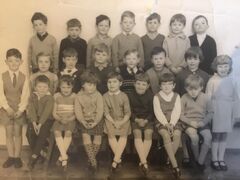 Now that the memory has been jogged by Steve's list I also recognise 2, 5, 15, 21 and agree with those names.
 -
11 is, I believe, John Gair of Third Street, Netherton.
-
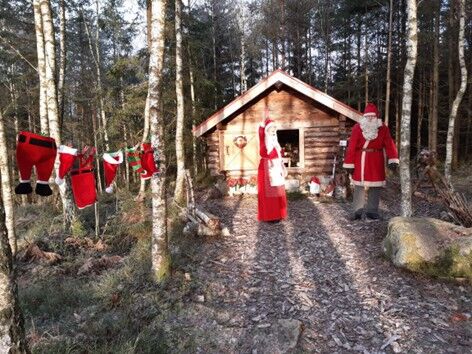
A woman's work is never done - not even when she's Mother Christmas! Just look at all that washing, it'll never dry in this weather! Merry Christmas everybody and all the very best for 2026.
-
-
Same here! I'm usually up to the knees and swinging a snow shovel every morning by now but, apart from a couple of inches in mid November, there's been nothing. Couldn't agree more about the cause and its source.
-
 Hi @Keith Harle I didn't know Mansel Dinnis but I had a quick look through the newspaper archives to see if there could be anything to help you. Unfortunately there wasn't a lot. He did indeed work for Caledonian Airways but only for a short while it seems, 1986 - 1988. Here are the few snippets of information I was able to find: 1971 He seems to have been working for BOAC and is reported on as having represented the company when giving a talk on the company’s organisation to the Elland Round Table. (Huddersfield Weekly Examiner) 1987 Mansel represents British Caledonian Airways (BCA) where he is sales manager, Scotland. He hands out the first prize (two tickets to Dallas USA) on behalf of BCA who donated the prize. (Dumfries and Galloway Standard) 1990 in October he joined the management team of the Westerwood Hotel, golf and country club. He is reported to previously have been British Caledonian’s sales manager in Scotland from 1986 to 1988 before operating his own management consultancy practice. The hotel is due to open early in 1991. (News & Chronicle) 1991 Just 3 months later, in January, he leaves “to pursue other business interests”. The general manager, Stanley Fredman resigns shortly after. The hotel is due to open in a couple of weeks so these two resignations make headlines in the local press. (Cumbernauld News) Of course, he may have returned to BCA at a later date. 2003 - 2005 he is on the electoral roll as resident in Selby, Yorkshire. Hope this is of some help to you.
 -
Go for it Mal!!!
-
Done! Good luck with this project, Malcolm. What a boost it would give to the area.
-
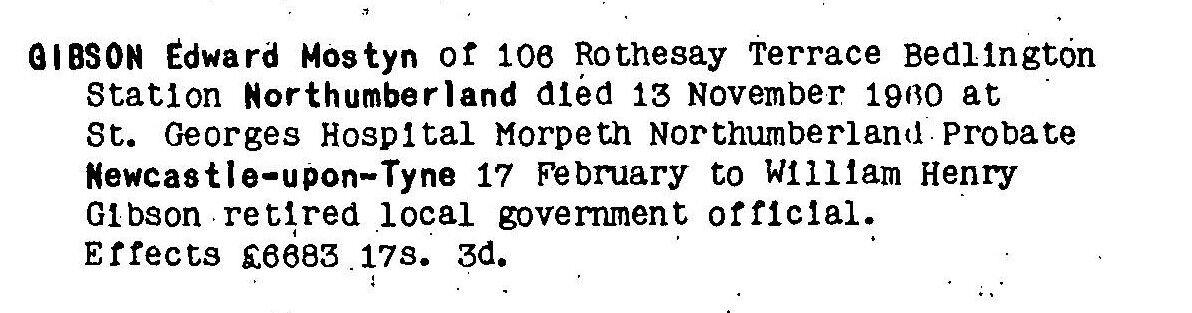
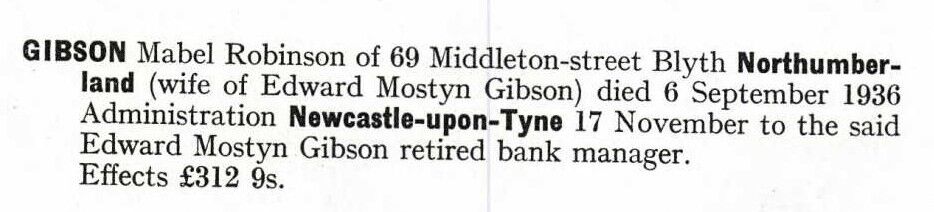
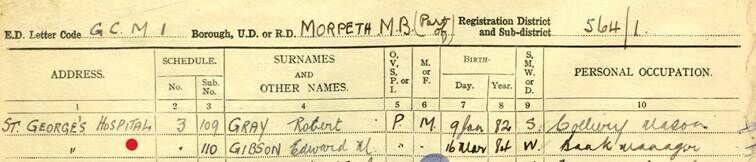
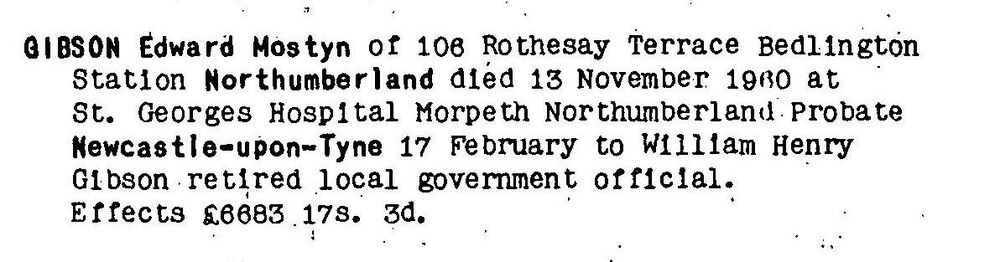
And finally, there was bank manager Edward Mostyn Gibson. What happened to him? He has been extremely difficult to find and here’s the reason why. In September 1936 Edward Mostyn’s wife, Mabel, dies at the age of 51 years. Her address is then given as Middleton Street, Blyth. One can only wonder why. After a great deal of searching I eventually found the first trace of Edward Mostyn’s whereabouts in 1939 – and possibly a reason for his wife being in Blyth. He was at that time a patient in St Georges Hospital, Morpeth. How long he had been there is impossible to say. Mental Health Care wasn’t exactly at it’s best in 1939 and admissions were more frequent than discharges. What I can say with certainty is that Edward Mostyn died in St George’s Hospital though, again, it’s impossible to say how long he had been there. At the time of his death, he did however own a home in Bedlington – 106 Rothesay Terrace – next door to his brother at 105 (106 was vacant in the 1939 register when Edward M was in hospital). Those effects are worth only £14,745 today. A sad end to an enterprising family and a big piece of Bedlington’s history. Hope you’ve enjoyed reading this as much as I’ve enjoyed researching it.
-
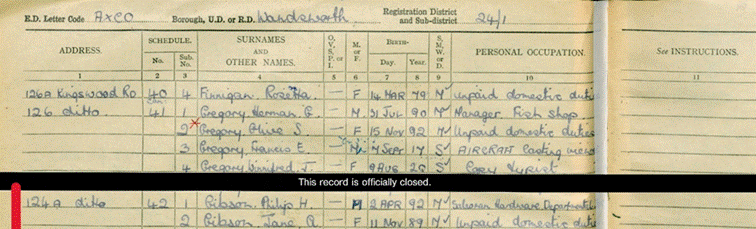
First and foremost, we can see that in 1939 Bank House was no longer in the possession of the Gibson family. It was now occupied by a mining family and, it seems to me, that the following family (at nr. 38) is living in the same building so possibly converted into flats. To come back to the youngest of the brothers, Philip Hedley Gibson, he seems to have continued in the field of selling. No doubt fuelled by his experience in the shop at Bank House, he has moved his family to the bright lights of Wandsworth, London where he is employed, not in any managerial position but as a salesman in a hardware department of a, presumably, larger, London store. Could one of his older brothers have taken on the ironmongers business in Bedlington? Unfortunately not. Brother William Henry Gibson continued to live on Rothesay Terrace but now at number 105. His occupation is then given as “Air Raid Precaution Clerk” with “Bedlington U, D, Council” so he has, presumably left the drapery business. Note that nr. 106 is vacant (V in margin). The place is not unoccupied but the resident is not available.


-
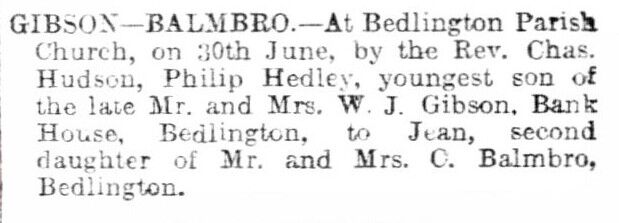
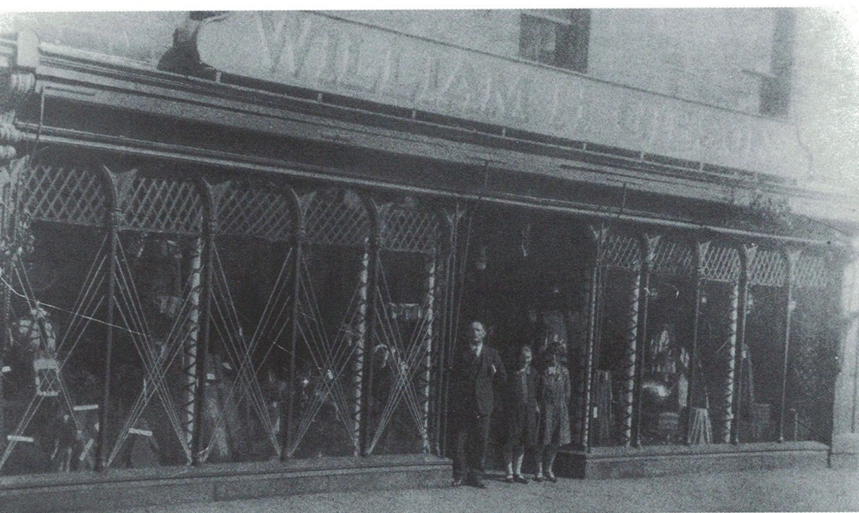
There has been very little information available after the 1911 census for the Gibson family but thanks to the release of the 1921 census research has now been made a little easier. In 1911 both Philip Hedley Gibson and his brother, Edward Mostyn Gibson were involved, albeit on different levels, with ironmongery. Edward M was, together with his father, joint manager in the ironmongery business. Philip H was working for them as an apprentice shopkeeper in the family shop at Bank House. After the death of their father, Edwin Mostyn takes over the management of the ironmongery business while continuing with his banking interests. Both Edwin and Philip are single and living at Bank House. In 1917 Edwin Mostyn marries. His bride is Mabel Robinson Turner of Blyth and she moves to her husband’s home. Three years later, in June 1920, Philip Hedley also marries and also brings his wife, Jean Balmbro, to Bank House. Jean appears to be the sister of his brother William Henry’s wife. Note: The name “Jean” would appear to be a misprint as her name is given as “Jane A” in the marriage index and as “Jane Ann” in the 1921 census. One year later, in 1921 the two sons and their wives are sharing the 10 rooms of Bank House. Philip H has completed his apprenticeship and is now entitled to call himself an ‘ironmonger’. He is stated to be an “employer” (rather than a worker, as previously) so seems to be in a managerial position in the business – if not the sole owner. I say the latter because his brother, Edward Mostyn, gives his occupation only as “Bank Manager” and his “employer” as “Bank of Liverpool and Martins Ltd.” but I can see from Kelly’s Directory that he is also engaged as “treasurer of the Urban District Council” of Bedlington. Both men give their place of work as “Front Street, Bedlington” so are presumably working from Bank House. By 1921 brother William Henry has left Bank House and has purchased a property at 89 Rothesay Terrace where he now lives. He is, however, still working at Hedley Young & Co. Ltd., drapers, on the south side of Front Street East, almost opposite Bank House. William Henry went on to become successful in his own drapery business and I’m sure you’ll recognise the premises, with its very distinctive arched windows, on Front Street East – the former ‘Dunns the Drapers’ which I’ve mentioned earlier in connection with the Gibson family. That’s William Henry in the shop doorway but I haven’t been able to identify the two girls. What happened to the three brothers and the family Ironmongers business after 1921? Fortunately, in September 1939, prior to the second world war which was looming on the horizon, the British Government decided to make an inventory of what human resources were available should they be needed. The gap is large between the census of 1921 and the ‘1939 register’, as it came to be known, and there is very little means of finding out which paths the brothers, William Henry, Philip Hedley and Edward Mostyn trod during those intervening years but we can get a glimpse of how it all turned out.
-
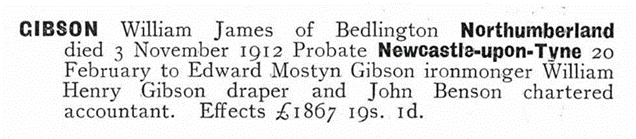
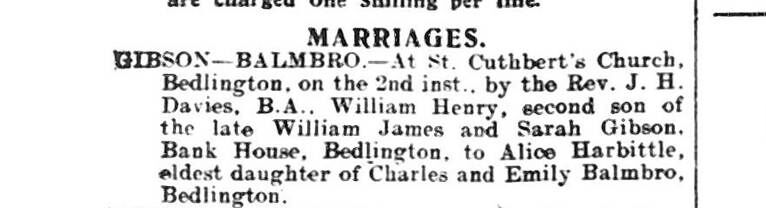
It's been a while but I have managed to do a fair bit of research between dahlias and geraniums. I'd like to get this finished before I fly off to the sun and return to piles of autumn leaves and snow. I've managed to get all my notes written up this week so here's the result. It'll probably need a few posts. Now, where did I leave off? Henry Gibson, head of the family, had died in 1902 at an age of 80 years. His son, Phillip Hedley Gibson – widowed and with no heirs – had followed him to the grave in 1906 leaving his brother, William James, to shoulder the responsibility of running the business. William James was then living in Vulcan Place with his wife Sarah (nee Mostyn) and their children: Mary, Edward Mostyn, William Henry, Lilian, James and Philip Hedley. However, by 1911 he and his family have moved back to Bank House on Front Street East. It has presumably been inherited after Philip’s death in 1906. There are, however, some notable changes in the family in 1911. William James Gibson is still in business as an “Ironmonger & Bank manager” and the property on front street is now described by the enumerator as being a “house and shop”. William James is also widowed but I haven’t been able to ascertain exactly where or when Sarah died. There is a death for a Sarah Gibson, 57 years old, registered in the first quarter of 1911 at Morpeth registry office – just prior to the census being done on April 2nd 1911. On that date three nieces of Sarah (daughters of Sarah’s two sisters), are shown on the census form as being at Bank House. Could they have been there because of Sarah’s death? Unfortunately, Sarah’s death has not been the only grief suffered by the family. In 1908 daughter Lilian had died aged 21 years, at which point, according to the newspaper obituary, her mother Sarah still lived and the family address is given as “North Eastern Bank” ie. Bank House. The only remaining daughter in 1911, Mary 28 years old, is still single and living at home, most likely taking care of the household now that her mother is gone. Also at home at Bank House are sons Edward Mostyn Gibson 27, William Henry Gibson 25, James Gibson 20 and Philip Hedley Gibson 19. The four sons were soon to be left fatherless, however, when William James Gibson dies November 3rd 1912 aged 57 years. He is sadly followed by son James, then 26 years old, in 1917. Those effects are worth approx. £275,450 today, so he didn’t do too badly either. Of the remaining three sons, only Edward Mostyn- and Philip Hedley Gibson have followed their father into the ironmongery business. The eldest, Edward Mostyn, is an ironmonger and also a bank clerk, while brother Philip Hedley concentrates solely on a career in ironmongering. At the age of 19 he is still learning the ropes as an apprentice shop-keeper, presumably in the family shop at Bank House but more about them later. Brother, William Henry, doesn’t appear to follow in the family trade choosing instead to follow his career in the drapery business. In 1911, now aged 25, he has completed his apprenticeship and is working as a draper’s shop assistant. The girl he will marry two years later in 1913, 23-year-old drapery colleague Alice Harbottle Balmbro, is also recorded as a visitor to Bank House in 1911. So, is this the end of an era for the Gibson Brothers Ironmongery business? Now, with their father dead and William H engaged in the drapery trade, only Edward Mostyn and Phillip Hedley remain to carry on the work started 88 years earlier by Phillip Gibson in 1814 – but will they do so?
-
What a great idea! Pity I don't live nearer.
-
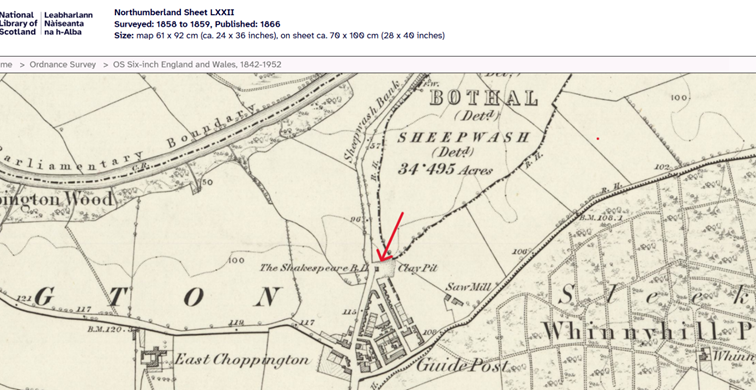
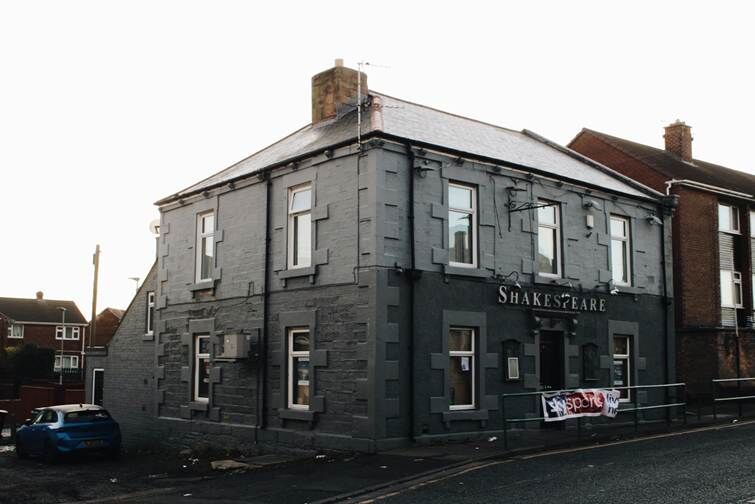
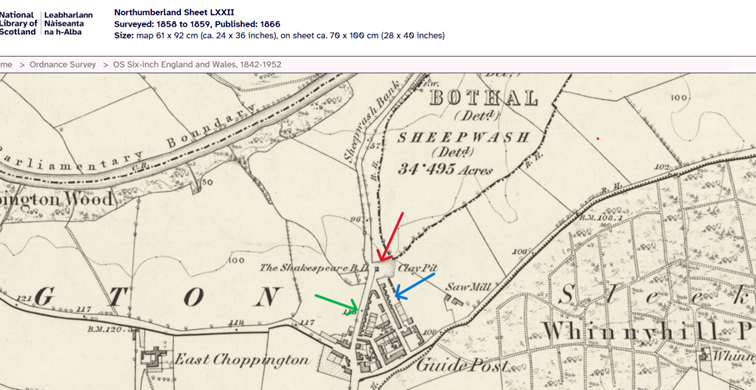
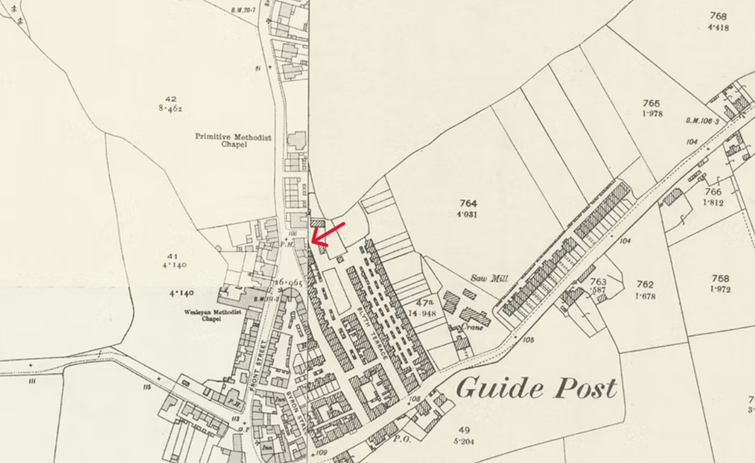
Hi @loopylou Your turn to make a cuppa! Have you ever heard the saying ‘Cherchez l femme’ (literally, ‘look for the woman,) commonly used in detective fiction when solving mysteries? I have my own version ‘cherchez la pub’ (literally, ‘look for the public house’) which I use in detective reality to solve the mysteries of family-whereabouts. While streets and roads often change their names public houses very rarely do and when it does happen, it’s often to a spin-off from the old name. If your relative is John Storey (wife A, children: S A, E and J I) then it’s possible not only to find the street but possibly even the house. Just follow the enumerator on his route until you find both your relative and the nearest pub. Often the pub is still in existence today. Using my ‘cherchez la pub’ method, I followed the route of the enumerator, Mr George Thornton, in the 1871 census: Parliamentary Borough of Morpeth – Parish of Bedlington – Ecclesiastical district of Choppington, Enumeration district 10. George Thornton, describes his enumeration district as “Guide Post East, West, North & South. Choppington, Choppington New Colliery, Bothal Haugh, Sheepwash Bank, Sheepwash & Cleesewell Hill, Stakeford Gate & Cottage in the wood”. Following the census on the 3rd of April 1871 he starts his rounds at the Angler’s Arms (schedule nr 1) at the bottom of Sheepwash Bank and continues up the bank along what is today the A1068 to schedule numbers 2 – 5. These 4 dwellings, simply have the address “Sheepwash Bank” which is located in the “Hamlet of Sheepwash Bank”. From there he proceeds straight ahead to the “Village of Guide Post” where the 7 families resident at schedule numbers 6 - 12 simply have the address “Guide Post”. Still in the “Village of Guide Post” he continues along “Sheepwash West Street” and visits the 16 families living there (schedule nrs. 16 – 28). Moving on, he enters “Sheepwash - East Row” (schedule nrs. 29 – 57) and its 29 families. At schedule nr. 36 I find Thomas Marsden – hopefully the same person you mentioned in your previous post. At schedule nr 45 I find, what I believe to be your relatives, John Storey and family, and low and behold at schedule nr. 54 I find the first public house on George’s round. It’s called The Shakespeare– and here it is on a map from 1866! You’ll see that The Shakespeare is marked BH. This is because it was originally (1850s) a Beer House (marked BH on OS maps rather than PH, Public House). At that time, according to the North East Heritage Library, it was the most northern building in the Village of Guide Post. Being a beer house meant that it was only allowed to sell ale whereas a public house could sell anything. Because of this restriction it was much cheaper to obtain a licence for a beer house. Here is the ‘Shakespeare’ today. If you live in the area you’ll probably recognize it as being on Front Street in Guide Post though this is not the original building. So, where did John Storey live? Between John Storeys residence and The Shakespeare there were only 8 dwellings so my guess is that “Sheepwash West Street’ and “Sheepwash East Row,” both in the village of Guide Post” are the following - in which case John lived towards the northern end of “Sheepwash East Row” (possible West Street arrowed green, possible East Row arrowed blue) just a stone’s throw from the beer house. However, there is another option. East Row probably changed its name and if the above blue-arrowed row is East Row, then it was built out between 1866 and the 1890s filling the gap between the northern end of “Sheepwash East Row” and The Shakespeare. You can see this development in this compilation of 2 maps from the 1890s on the left and the 1920s on the right (The Shakespeare marked in red on the 1890s side and now a PH). If this development occurred between 1866 and 1871 when the census was completed, he would have lived in the new development. What about Thomas Marsden? A possible explanation for Guide Post vs. Scotland Gate may be a district boundary change. Just a thought! I hope this was of use to you and that you yourself might find a use for my ‘cherchez la pub’ method. If you want any of the documentation I've researched give me a shout.
-
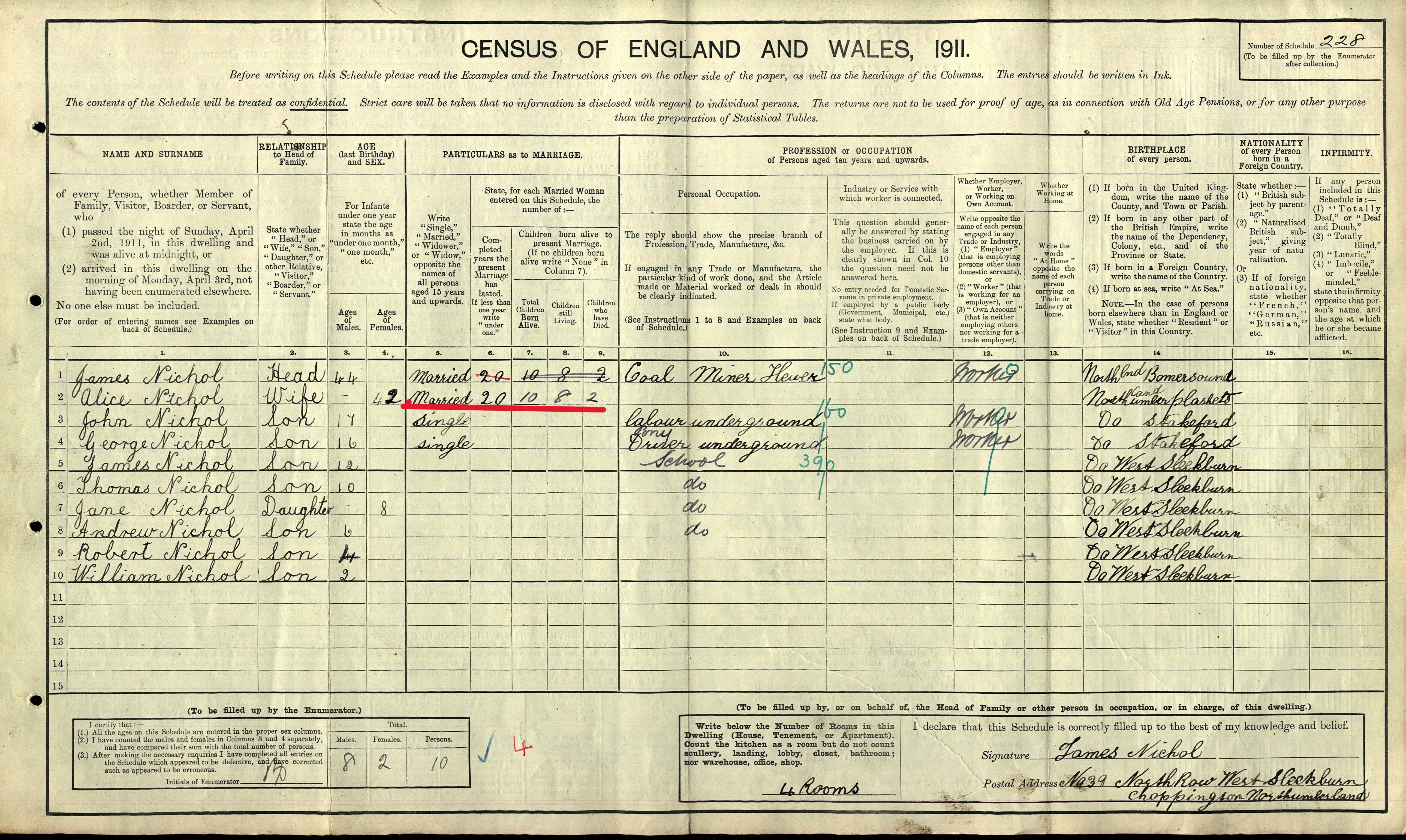
@Colin Nichol Make yourself a cuppa. This may be long! I think, Colin, that you probably made ‘a couple’ of mistakes. Haven’t we all! When we research our family history, we usually start with those nearest in line and work backwards in time: parents, grandparents, great grandparents etc. At that stage, it’s fair to assume that we are beginners in the field of genealogy. Some of the most common mistakes I’ve come across in my 15 years of researching almost every week are the following: 1 Taking for granted that other people’s trees are correct. We look at other people’s family trees and take for granted that they are correct. OFTEN THEY ARE NOT!! Believe me, I’ve been their myself. Always check the information before adding it to your own family tree. By doing this check you will save yourself hours of work later in your research AND you will save other beginners from making mistakes when they look at your tree. 2 Confusing ‘date of birth’ with ‘date of registration of a birth’. A correct date of birth is only found on a birth certificate. The birth index gives the date on which the birth was registered. This can occur several months after a birth for several reasons. This is especially confusing when a birth occurs at the end of one year and is registered at the beginning of the following year. If you want to be certain, obtain a birth certificate copy. 3 Confusing the place of birth with the place of registration. An accurate place of birth is only found on a birth certificate. The birth index gives only the place of registration. Since 1834 England and Wales share a joint birth, marriage, death (and census register). England has 60 County Registration Districts, Wales has 21. (The same registration districts are used to compile the census since 1851) Each County Registration District covers several civil registration districts so called ‘sub-districts’. Some small changes have occurred over the years as parish and county boundaries have changed. Particularly interesting for us Bedlingtonians is the Northumberland County Registration District – and here’s something that may be of interest to you Colin – the ancient county of Northumberland 1834 – 1889 included the town of Berwick on Tweed. Registration districts could even cross boundaries. The Northumberland district has 18 sub-registration districts. One of these which might interest you, Colin, is the sub-district of ‘Bellingham’. You mentioned this a place of birth for Mary Alice but it is (unless you’ve seen a birth certificate) the name of the registration district in which her birth was registered. Each sub-registration district was made up of a number of parishes (which is why the parish name appears at the top of census records). Again, maybe of interest to you, the registration district of Bellingham had 38 parishes one of which was ‘Plashetts and Tynehead’. The registration district of Bellingham was abolished in 1936 and most sub-districts were then incorporated into the Northumberland West Registration District. 4 Getting hung up on names. Names can vary for one and the same person, from census to census. Parents filling in the census forms, more often than not, write the name they use for the child at home (often a diminutive or just one of their two registered forenames). The only accurate name of a child (or wife) is the name that appears in the birth register or birth certificate. So, Winifred Ellen Smith may be written as: Winifred Ellen, Winifred, Ellen, Winnie Ellen, just plain old Winnie or even Nelly. (Those examples all relate to a member of my family). And finally, you’ll be pleased to hear, we should always remember that the enumerator who conducted the local census inquiry was, like the rest of us, only human. He could – and did – make mistakes when transcribing the content of your relatives (often almost illegible) form to his book, the one that is available to us. Do you recognise yourself in any of those beginner’s errors, Colin? Have another look at all the documents I messaged to you. Pay particular attention to children’s names, order of birth, ages and place of birth (not always exactly the same but most within the same registration district (Falstone – 1881 census - is just 4 miles south east of Plashetts). The one exception is ‘Scotland’. That could be explained by an enumerator’s error/ignorance or the fact that the exact location of the England/Scotland border was long a subject of dispute. Just a thought! I personally don’t think that Mary Alice Snowdon was born in Canonbie Scotland. That person is named only Mary in the birth index. She, according to the Scottish Births and Baptisms records, was born 01 Aug 1869. You have confirmed to me that I have located the correct Mary Alice Snowdon (married name Nichol) in the 1911 census where she gives her age as 42 years. In the 1921 census people were required to give their age in years and months which makes it easier to calculate a birthday. The 1921 census took place 19/20th June. Looking at Mary Alice’s entry, her age is given as 52 years and 6 months. From that, I calculate that she was born in December 1868. Her birth wasn’t registered until a couple of weeks later when 1869 had already been ushered in. Sorry, it's a lot to take in, I know. Let me know how you get on.
-
Back to the drawing board then!!
-
Hi @Colin Nichol. In reply to your message: when searching for a child death without knowing the name it's always worth looking up the child's grandparents. The Victorians were usually quite consistent in naming their offspring: 1st son named after his maternal grandfather 1st daughter named after her paternal grandmother 2nd son named after his paternal grandfather 2nd daughter named after her maternal grandmother Thereafter came parents names and important relatives. Towards the end of the Victorian era the order of naming wasn't any longer so strictly followed but the practice of using the names of just those relatives lived on into the early 20th century. Ann Margaret seems to have been a name worth preserving among the Snowdons. James and Mary Alice's first child, Annie Margaret was given her maternal grandmother's name. That maternal grandmother had also given her first daughter that name. (that child also died before the age of 15). The name was then 'vacant' for future children therefore I searched for it in the birth index during the years between the births of George and James where the time-span allowed for a pregnancy. Of course, you would need to obtain a birth certificate to verify that James and Mary Alice are the parents but I think the chances are good. Hope this explains the need for the census documents.
-
Hi @loopylou, could you check the year of that obituary for me (my BNA is down for maintainence at the minute). The death record that I found was 1892. If it was 1893 then it throws my research of balance a bit. Thanks in advance.
-
Pleased to have been of help. I think I may have found the other child who died between 1901 and 1911. I believe that James and Mary Alice had another daughter born in the first quarter of 1897. That would fit in nicely with the gap between the births of George and James. There are no other gaps which would allow for a pregnancy between 1901 and 1911. The firstborn daughter, Annie Margaret Nichol born 1891, was given her maternal grandmother’s name and her birth was registered as Annie Margaret. What I believe to be the second daughter, born 1897, was also given her maternal grandmother’s name but without the diminutive form. Her birth was registered as Ann Margaret Nichol. She died the following year and her death was registered in March 1898 but then using the name Annie Margaret Nichol. She was also buried in Cambois. That parents ‘recycled’ names isn’t uncommon, especially if it was the name of a grandparent or parent. I myself am a perfect example. My mother gave birth to a daughter in 1931 and gave that daughter her maternal grandmother’s name – Annie. The child, Annie, lived only a few months. I was born in 1947 and was also given my maternal grandmother’s name though without the diminutive form – Ann. Like you, I never knew anything about Annie (or another brother dead before my birth) until I was in my 70s. They were never mentioned. The discovery of a sister named Annie explained something that had puzzled me for years. My mother always called me Ann. Everybody else called me Annie. My mother had one Annie and one Ann and for a mother the one could never replace the other. If you would like the birth, death and burial indexes for Ann Margaret born 1897 let me know and I’ll post them to your in-box (the envelope in the top tight-hand corner of the screen).
-
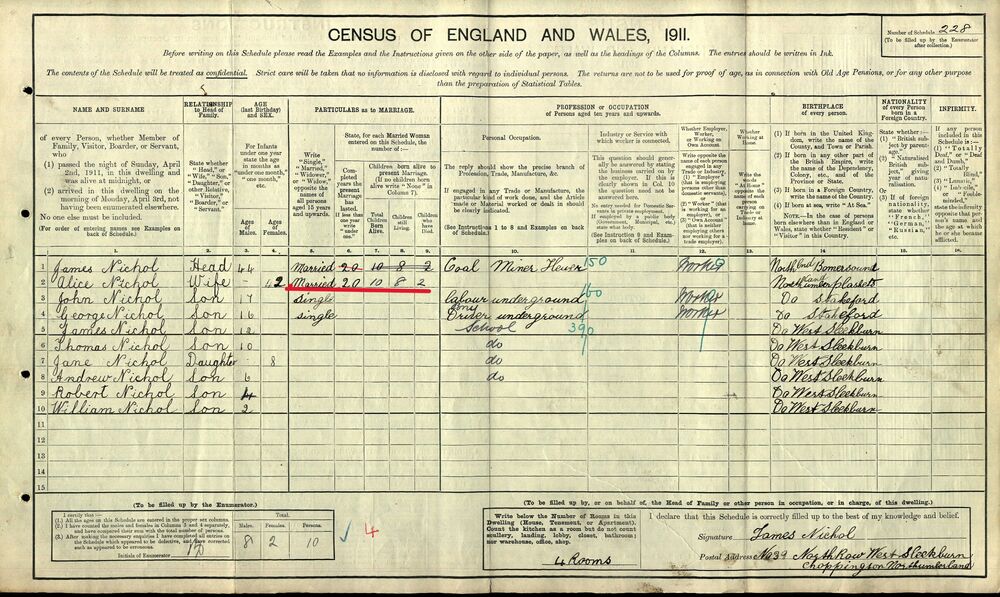
Hi again @Colin Nichol. The 1911 census form filled in by James himself gives the information related to the length of the marriage and the number of children living and dead. I also would assume that St Peters is the burial place of Annie Margaret. However, money was tight in those days so she may be buried in another person's grave as she was so young. It was common practice for an infant to be placed inside the coffin of the next adult to be buried.
-
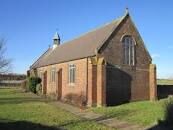
Hi @Colin Nichol Welcome to the forum. The parish of Cambois was originally part of St Cuthbert's, Bedlington, it was a small parish served by the vicar of Sleekburn and a non-stipendiary priest. The Cambois church, St Andrews, is a small church built in 1860. It was formerly the mission church of St Peter's Church, West Sleekburn until it closed in the 1990s. As a mission church it did not have a graveyard so burials took place at St Peter's, West Sleekburn. Cambois, St Peter: Records of baptisms 1865-1936, marriages 1866-1998 and burials 1874-1966 are available at Northumberland Archives Service. P.S.Did you know that James and Mary Alice lost a second child within the first 10 years of their marriage?

-
Hi @BMog Sorry, I don't know what happened above. It just wouldn't let me write or delete anything! Mary's marriage was registered in Durham registration district which includes the city of Durham. This doesn't necessarily mean that she lived - or was married - in the parish of Durham. The Durham registration district had, in 1904 when she married, at least 37 different parishes. Couples usually married in the bride's parish so what you need is a copy of the marriage certificate which you can obtain from the GRO. Many certificates are now digitalized and can be bought as a pdf file - much cheaper than the paper copies. The certificate will give you the address of both Mary and Henry as well the parish in which they married. That will give yo more information to work while trying to find his employer - or place of business if he was self employed. If the latter is correct then you can try the directories and gazettes. Hope this helps. Good luck with your research.
.thumb.jpg.7493ddab4a696108cf2b849323d3c155.jpg)