

.jpg.cdd7f8371d17e2f2f2e2a0e21e02f727.jpg)
.jpg.a8059e59bff91bf6691d0bfedf8fad60.jpg)
Everything posted by Canny lass
-
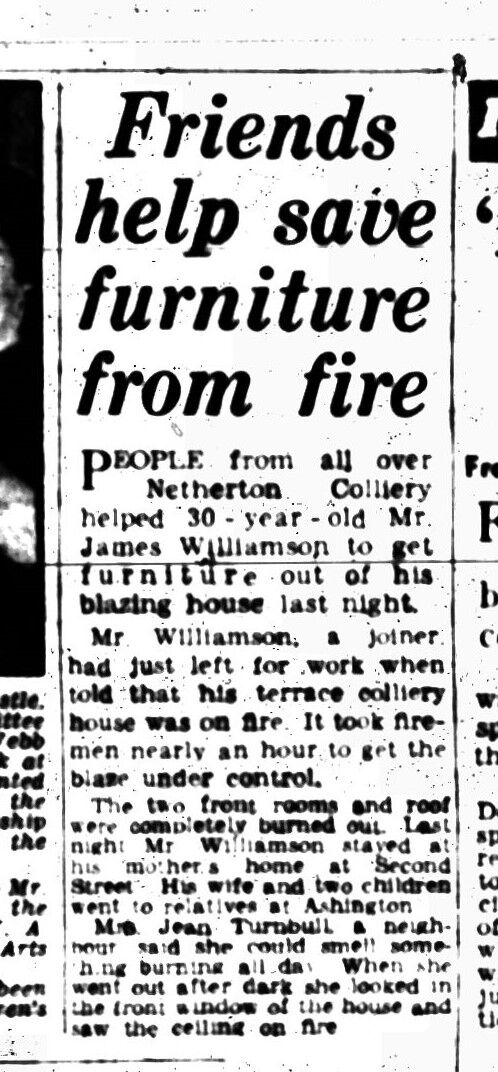
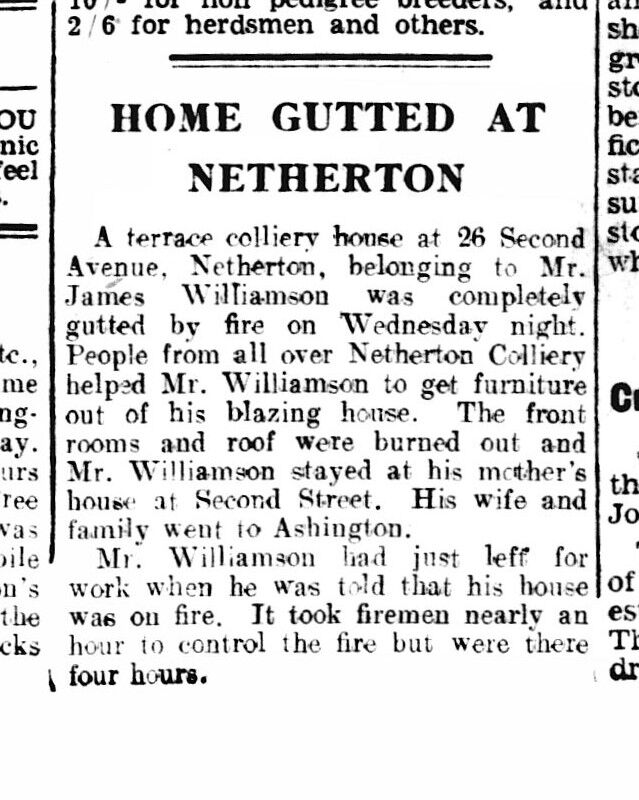
Here's one that Bob might appreciate more as his mother gets a mention. The Newcastle Journal was a bit quicker in reporting as it had a daily edition while the Morpeth herald only had a weekly.
-
Nr 1 Third Street needs a bit of investigation. There was a green, wooden, lean-to building on nr 1 which housed the unlikely combination of a Dr's surgery and a chip shop. The latter was, I believe, the cause of he fire. I know I've done a bit of research on it at some time. I'll have a rummage and see what I come up with.
-
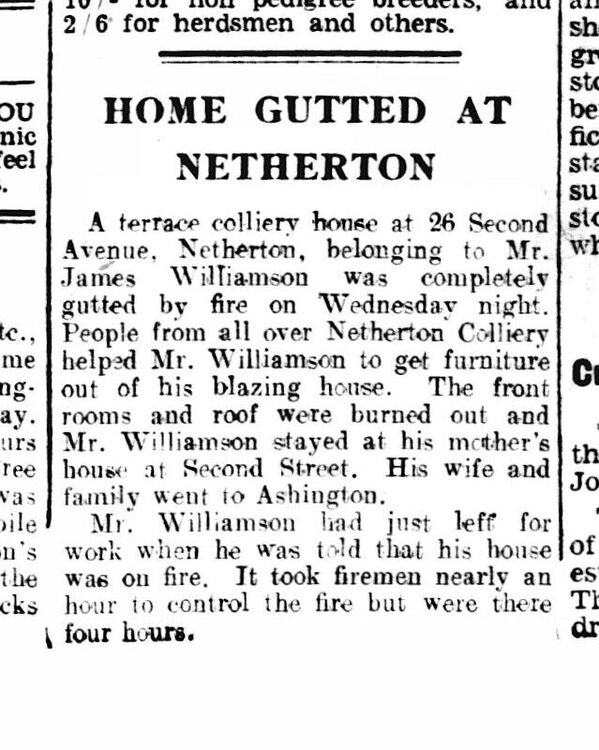
February 10th 1954. I can just remember it and it was reported in the Morpeth Herald Friday 12th 1954.
-
Am I reading that correctly Mal, 2039 for the parking? The new station will be ready for renovering by then.
-
@Alan Edgar (Eggy1948) @Symptoms ...all of those 14 things plus: 1 Mickey Mouse will be the UK's prime minister. He'll need to have a long distance relationship with Minnie because she'll be in the Oval Office multi-tasking with housework, running the country and preparing a womanfesto for the next erec... (sorry FHF again, plus, I must take more water with my whisky) election. 2 Bedlington will receive millions from Mickey's government to prepare Bedlington for the hosting of the next winter olympics. The mascot, a giant size inflatable Bedlington Terrier will hover over the ski-slope, aka Bedlington bank, throughout the duration of the games. 3 The seats in Wetminster will be reupholstered in a high quality, waterproof, black and white striped material. 4 Included in the responsibilities and powers of the Speaker of the House of Commons is the punishment of offenders. Such punishments will now include those of a corporal nature. Wrist-slapping will no longer be curtailed to the verbal variety. Standing in a corner may also be added to the list of punishments allowed. TV-coverage will be so much more fun. 5 Black Rod will be called Red Rod and her knock should be answered by all MPs simultaneously singing a chorus of Mary Hopkin's Knock knock who's there? 6 Yorkshire puddings, having held the monopoly on the name for far too many years, will now be called Northumberland puddings. 7 Parliamentary night sittings will become night standings. That should put a stop to that mullarkey.
-
The first two lines of Nichi’s article say it all. ” What do undecided women voters want? That’s the question prickling many a Westminster wonk ahead of our July 4 election.” Westminster wonk? Please, somebody, anybody, tell me that’s a spelling mistake and make my day! In this erect… (sorry, must be too much FHF), election the risk is, I believe, minimal. Big Dicky’s tie is a direct no-no! Anybody needing a tie that long to point the way to his er… brain (despite his pet-name) is not going to get many female votes. They are wasting their breath, time and money with their manifestos. What we women need are womanfestos to help us decide and if we women reach Erect… (sorry, it’s that FHF thing again) Election Day, untouched by the main political parties’ attempts to woo us then we have a very efficient and reliable method for making that all important, final decision: Lick the index finger of the right hand, close both eyes, circle the licked finger three times in a clockwise direction at shoulder level, quickly move the finger in a downward direction until contact is made with the voting slip, open both eyes and place a cross at the point covered by the tip of the index finger. Never fails!!
-
That brought back a few memories!
-
Fantastic bit of detective work!
-
 I just love these old photos!
 -
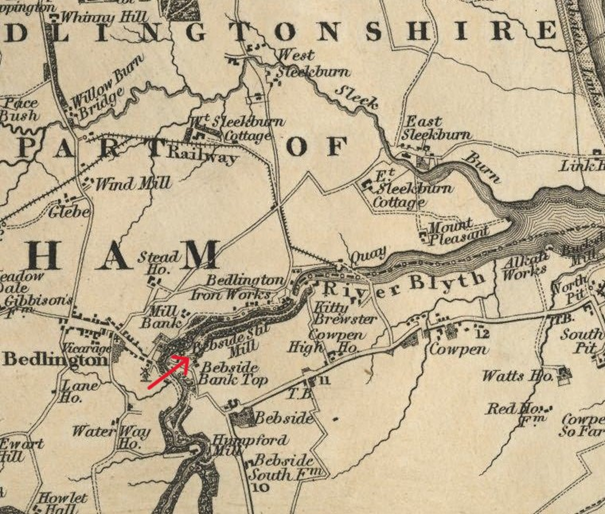
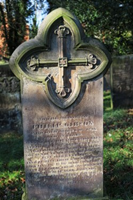
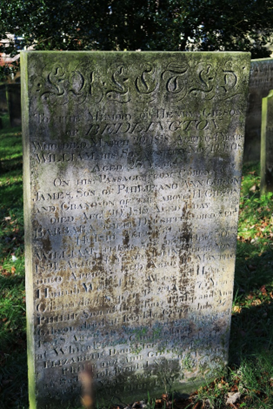
part 2. Sorry you've had to wait but my geraniums, fuchsias, dahlias and vegetable patch couldn't! Part 2 The Gibson family When Henry and Hannah Gibson experienced the sorrow of losing a child, albeit an adult child, in 1808 they probably couldn’t begin to imagine the sorrow which their son, Philip, and his wife Ann would start to endure just seven years later. Together, Philip and Ann had at least ten children. The firstborn, Henry born 1814, was followed by son James in 1815 but James lived only one day. The next child, daughter Barbara, was born 1816 and died at just 39 days old. The following year, 1817, a third son is born. He is named William but dies before reaching the age of four. As if this wasn’t enough, Philip’s father, Henry, also dies in 1818 and a further son, John born 1824, dies at the age of ten months. The children James, Barbara, William and John are also remembered on their grandfather’s gravestone, shown in my previous post. What a start to a marriage! Four infant deaths and Ann was probably pregnant on the occasion of each. She must have been a really tough woman – which later history in fact confirms. However, it’s not all doom and gloom for Philip and Ann. As well as the firstborn, Henry, there are five other survivors. Ann born 1820, lives to be 58 years old and Philip, born 1822, lives to be 36. At the time of his death, in Keekle near Whitehaven, Cumberland, he was unmarried and engineer to the Whitehaven Cleator and Egremont Railway. His sister Elizabeth, born 1827, dies also in Cumberland unmarried at the age of 69. Brother James, born 1829, reaches the age of 49 and the youngest, another Barbara* born 1916, attains the great age of 85 years. (*it was then common practice to re-use the names of children who had previously died. These were family names intended to ’live on’ in the family). Where in Bedlington the family lives is initially difficult to determine as postal addresses were almost non-existant but here is ample evidence that the family resided in Bedlington’s East End where the family business is recorded as early as 1814 and by 1841 it is evident that Philip and Ann lived in a house on Front Street in Bedlington’s East End and adjacent to the entrance to Bell’s Place – the house which now has a blue plaque. About the time of baby Henry’s birth in 1814, Philip’s entrepreneurial side comes into evidence when he, a grocer and draper, branches out into the world of iron goods – more specifically, nail making. His location on Front Street East is perfectly situated for this enterprise, just a stone’s throw from the Bebside slit mill which could provide materials (shown below on Greenwood’s map of 1828) and the river Blyth which provided a means of transport for the finished product by keel boat to the port of Blyth for further distribution nationwide – and perhaps even world wide, as the British Empire grew. Just where Philip’s workshop was located isn’t known and initially there may not have been any workshop. Nail-making was, at least in the Midlands, predominantly a cottage industry and I can find nothing to suggest that it wasn’t so even in Bedlington. The master nailer would purchase rods of iron from the slitting/slit mill. These were then distributed to nailers who hammered a point at one end and a flat head at the other. The finished article was then collected for shipment and the nailer was paid for his work which more often than not took place in a lean-to shed at a simple two up one-down nailer’s cottage which probably housed two families. This had the benefit that even wives and children could help in the work. Well worth a read is https://bromsgrovenailmaking.wixsite.com/nail-making/untitled-c139r a graphic description of the nail trade in Bromsgrove. The type of trade described there had it’s negative aspects in regard to payment of nailers though I am not suggesting that the Gibson family were engaged in anything of that nature. However, at some point Philip did have a workshop and it is documented that his son Henry ”after leaving school, served his apprenticeship as a chainmaker with his father” and worked at his trade for many years in ”his father’s workshop” (Morpeth Herald 12 APR 1902). In 1941 Philip, then about 50 years old, gives his occupation only as ”grocer” and his sons Henry and Philip, appear to have become involved in the industrial side of the business which has developed to include chainmaking. The youngest son, James, is still at school but will, on leaving, join the firm. Sadly, some five years later in 1846, Philip passes away after a short illness, aged 59 years. He is also buried in St Cuthbert’s churchyard. The business falls to his widow, Ann who continues to run it with the help of sons Henry, Philip and James. By 1855 the nail and chain manufacturing side of the business has expanded to include a blacksmith’s shop. The drapery side of the business has ceased to exist but in its wake appears an ironmonger’s business. Philip and James are named as managers of all aspects of the business. While Henry seems to concentrate on chain-making. The family clearly has a goodhead head for business and now has a finger in several of Bedlington’s trade and industry pies. To be continued. Note: It’s always difficult with ages and dates unless birth and marriage certificates are obtained. It is therefore advisable to think +/- 2 years on everything.
-
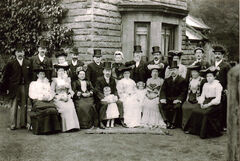
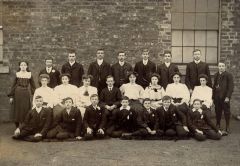 Sorry, this is in bits and pieces ... As Mr Boll Sr. was schoolmaster at the village school throughout his career then I think it's fair to assume that this is him (standing at the back) in the photo from 1902. He bears a bit of a resemblance to the man standing centre back (with moustache) in the group photo.
 -
William Henry Jr was born in Netherton Village and like his father went into teaching. In 1916, living in School House with his parents, he goes to war. Luckily he survives and in 1921 he is engaged in full-time studies to become a teacher. He marries a Newcastle girl in 1929 and they move away from the area at some point within the following 10 years. Certainly in 1939 he is living in Penrith and employed as a schoolmaster but he and the family seem to move back to Newcastle as he dies there in 1963. I have never been able to find any evidence that either of the two worked in the infant school in the colliery. I've scrutinised the group above and if it is correctly dated to 1912 Mr Boll Sr would be 50 years old. Mr Boll Jr. would be 14 years old. The latter could be one of the older boys but I don't know if there are any 50 year-olds there. It seems like a family group to me.
-
Sorry, half of my post disappeared because I took too long editing (I must learn how to add photos throughout the text!) To continue where I left off... He was born in 1862 and seems to have done very well for himself. By the age of 18 he was a "pupil teacher' in West Hartford where the family then lived due to his father's work. Ten years later the family is living in Nedderton Village where William Henry Junior is schoolmaster at the school and his father is again working in one of the Netherton mines. His home is then "School House, Netherton Village". The year is 1891 and that "School House" may well have been within the school itself. By 1901 William Henry is a "Certified Elementary Schoolmaster" and he remains at School House throughout his career. He was certainly still there in 1929 and still working. In 1911 the building in which he lived is described as a "Council School and private house" which is why I think the accommodation may have been in the school building. It is not until 1920 that School House appears on any maps I've seen and that's the brick-built house immediately to the right of the old school building (marked red on the map below). I've also arrowed the previously mentioned Rowanbrae in blue. It's at this address William Henry Sr, lives until at least his retirement. Prior to it's appearance on this map the land to the east of the school was without buildings.
-
No, I don't remember Mr & Mrs Boll from the 1960s but if there was a Mr Boll living to the left of the school in the 60s then it wasn't Mr Boll the schoolmaster because he died in 1950. However, he did die at Rowanbrae which still stands today somewhat to the left of the school building and adjacent to the old hall. There were two 'Mr Boll' - father and son both named William Henry and both School teachers. Mr Boll Sr was actually born in Netherton in Old Colliery Row which was very close to what we know as Nedderton Village. His father was a miner.
-
The Gibson's were an interesting family well worthy of a it of research. Here's the start of a few posts that may help you get acquainted with them and their business. August 28 1753 a wedding, which will eventually lead to a blue plaque being placed on the house currently known as 34 and 36 Front Street East, Bedlington, takes place at St Cuthbert’s Church in the town. The house is the former home of the Gibson family – the last of the Bedlington nailers. The groom is 23 year old Humphrey Gibson, and his 21 year old bride is a Bedlington girl, Ann Stephenson. In March the following year, 1754, the couple’s are once again in St Cuthbert’s Church, this time to celebrate the baptism of their firstborn – twins William and Henry Gibson. Very little else is known of Humphrey and Ann, though it’s possible to assume that Ann dies young as Humphrey remarries in 1766 when the twins are just 12 years old. His bride on this occasion is Isabel Moss. Of the twin William I can find no information but Henry is raised in Bedlington. He later meets his wife, Stannington-born Hannah Jameson and they also marry at St Cuthbert’s in November 1784 when both are 30 years old. Together the couple have five known children: William born 1785, Philip born 1788, Henry born 1790, Ann born 1792 and Hannah born 1794. November 19th 1808 their oldest son William, then aged 23 years, is lost on a passage from Corunna, Spain, where he is a mate on board the Providence, an army transport returning from the Peninsular War – part of the wider Napoleonic wars. Almost home, the ship and all hands are lost in a storm at Bolt Head near Salcombe, Devon and the master, Robert Denton, is the only survivor. (Source: McDonald, K., 1992, The Bolt-Whole, 84 (Article in Serial). SDV147889). William’s body is recovered but is not returned to Bedlington for burial. Instead, he is interred at Malborough, Devon. He is, however, remembered on his father’s gravestone in St Cuthbert’s churchyard. It is left to Henry and Hannah’s second son, Philip, to carry the Gibson name forward and in doing so he leaves a lasting footprint on Bedlington. In 1812 at the age of about 24 years, Philip marries 20 year-old Ann Rutherford in her parish church at Stannington and just two years later, in 1814, he lays the foundations for a company that will become the last chain and nail manufacturer in Bedlington. Fourteen years after the company’s founding Pigot and Co, in their county directory of 1828, describe Bedlington in the following manner: ”With the exception of the iron works here, which are supposed to be the largest in the north of England, this place contains nothing worthy of notice either to the inquisitive tourist or the man of business.” This ”nothing of interest” included Philip Gibson who’s name is listed in two categories of traders: ”nail makers” and ”shopkeepers & dealers in sundries”. Philip, along with 5 further shopkeepers, 1 further nail maker, 4 blacksmiths, 5 boot & shoe-makers, 4 butchers, 3 cartwrights & joiners, 2 coal owners & merchants, 2 corn millers, 2 dressmakers, 5 grocers & drapers, 9 inn-, tavern- & public house keepers, 1 iron founder, 1 joiner, 6 stone masons, 2 tailors, 1 baker, 1 veterinary surgeon, 1 saddler and 1 ’clogger’, is part of Bedlington’s ’business sector’ at that time. Of Pigot’s description to judge, none of them appear to have made any noteworthy impression during his inspection in 1828 yet the company founded by Philip Gibson had already survived into it's fourteenth year and would become a household name in Bedlingtonshire for well over a hundred years. The Gibson’s appear to have been a family with a head for business and subsequent generations of Gibson’s would play an important role in developing and diversifying the business from the house on Front Street East. Over the next few weeks I’ll try to relate what my research has discovered. Have patience though, the gardening season is in full swing here and I have to make outdoor use of any fine day that comes my way.
-
@stustep Yes, it certainly is but there is a connection between Dunn's the Drapers and the Gibson family. Mary Ellen Gibson, born 1852 to Henry Gibson (credited with being the founder of the chain & nail business) and his wife Mary, married draper Lewis Dunn in 1877 and left the family home (Bank House) to join her husband above the shop further up the street. She and Lewis had four children. Unfortunately, Lewis died aged about 40 years in 1885 leaving Mary a widow at the age of 33 with four children - the youngest only months old. She continued to run the drapery business until at least 1891 and possibly longer. In 1901 she and 3 of her children were once again living in Bank House together with her brother and their now frail and infirm father Henry, Be careful! It can get quite addictive!
-
I was a bit confused as well Vic. The place I'm talking about is shown above running from the gable-end on the left and covering the first three upstairs windows. Downstairs there's one window on the left of the entrance door followed by the windows of the bank (formerly part of the Gibson home) and the blocked entrance to the bank.This house had originally only 8 rooms and a kitchen. The ground floor plan from the 1970s includes even the adjoining building.
-
Hoping to update The Last of the Nailers by the end of the week.
-
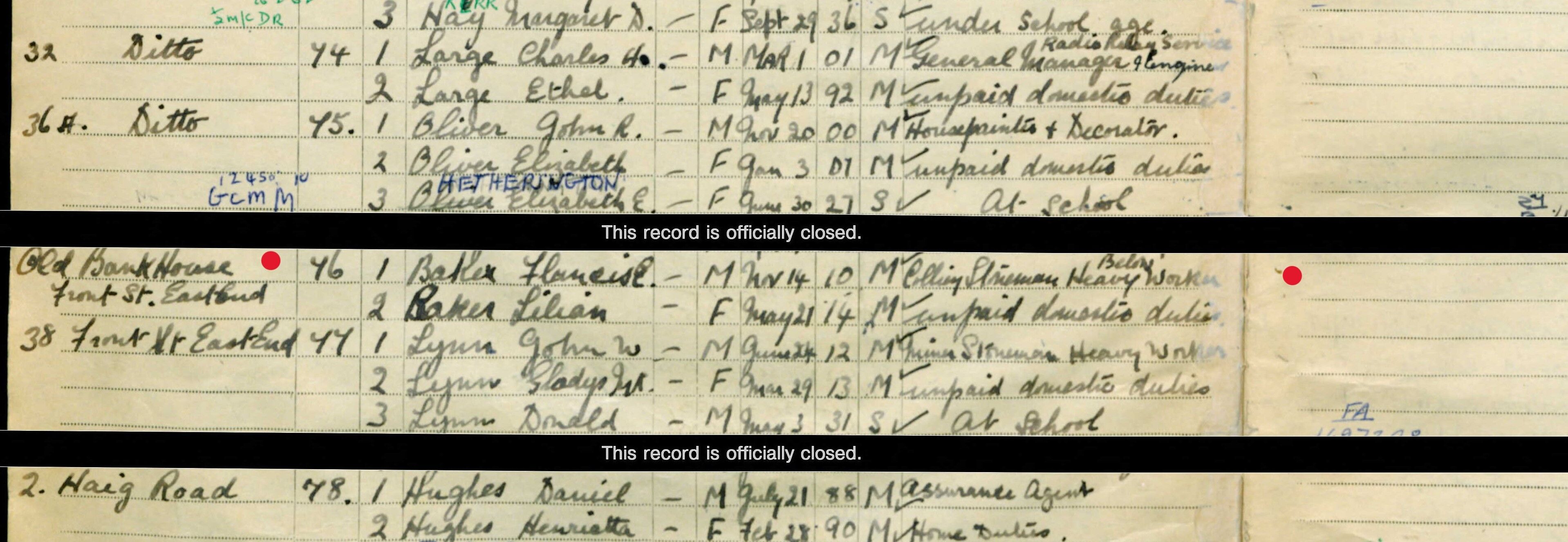
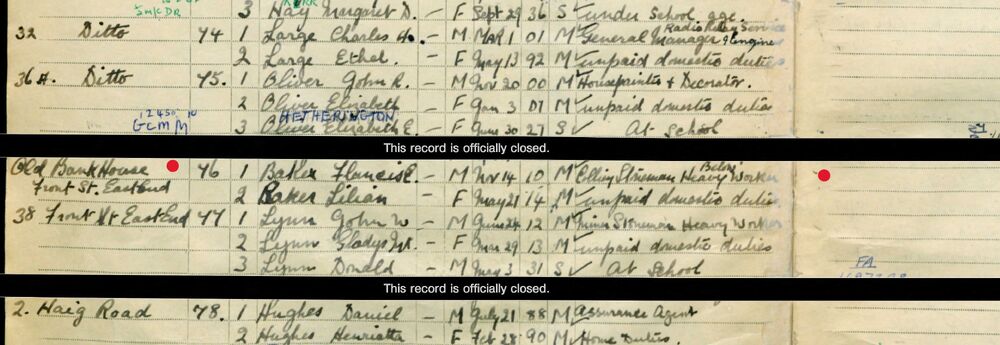
@stustep Good work Stustep! That’s saved me a great deal of research. At great risk of revealing my age I can say that I remember City Vending early 70s – or possibly even late 60s – though I thought it was a bit further down the street but could be wrong. When you talk about 34 – 38 Front Street are you referring to ’dwellings’ all in the same building, ie the building that housed the bank? I’ve come as far as 1939 and at that point the building may already have been three dwellings. Certainly, there are no Gibson’s living there in 1939. As you can see 36 now has an additional 4. This may later have become number 34. Number 38 hasn’t been there on previous documents where Bank House was the last house on the corner. However, it’s not impossible that the bank was stiil there as well. There was certainly a bank manager living there in 1936 but he was ’indisposed’ (for want of a better word) in 1939, However he was still referred to as a bank manager. More about that later. Somewhat confusing is that it’s called ”Old” Bank House – suggesting that it’s no longer a bank. However, they did have a sub-branch at Bedlington Station.
-
Coming soon! This is an interesting family and I've been researching them this week. I'll post soon, probably on John Dawson's thread The Last of the Nailers. It will probably be long so it may need a few posts.
-
PS Have you read John Dawson's topic 'The last of the Nailers' in History Hollow?
-
Hi @stustep and welcome to the forum. The Gibson nailers get a mention in Graces Guide https://www.gracesguide.co.uk/Bedlington_Ironworks where you can read that: "During the first quarter of the nineteenth century the splitting mills became disused at the Bedlington works, and soon after that all the nailers shops, apart from one, disappeared from the town. The last shop belonged to the Gibson family and can be traced back to the beginning of the last century. Mr. Gibson says he was forced to finally pull down the shutters of his shop in 1930. He has since been known in Bedlington and district as "The last of the Nailers". Hope this is of use to you.
-
@ms_lighthouse happy to have been able to help.
-
Thanks Eggy. Strange thing is, on several websites I get a pop-up telling me that the site is not secure and a choice to continue or abort my search but this doesn't happen with DMM.
-
@Alan Edgar (Eggy1948) Well, I got him to look at it and he 'clarted' all day with no luck. He wonders if it has anything to do with my having bought a new laptop and iphone exactly one year ago when something called F-secure was installed (Part of the package I bought). I thought I'd had the problem over a year but maybe I'm wrong.
.thumb.jpg.7493ddab4a696108cf2b849323d3c155.jpg)